



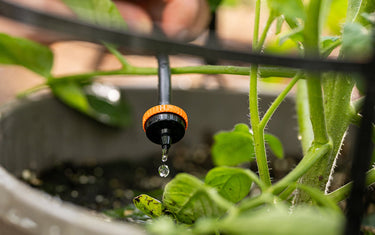
Drip irrigation delivers water directly to the root zone which means lower water use, healthier plants and fewer compatibility issues if you plan the system correctly.
Drip irrigation is gaining ground as water restrictions tighten and homeowners look for ways to reduce outdoor water use. The system delivers water at low flow rates directly to the root zone, which reduces evaporation, eliminates overspray and keeps foliage dry — an important factor in disease-prone planting beds.
The questions below address the two most common points of confusion when adding or converting to drip: whether a separate valve is needed, and how to select the right pressure regulator.
Do I Need a Separate Valve for a Drip System?
That depends on whether you are replacing an existing sprinkler system entirely or adding drip alongside it.
Full replacement: If drip is replacing the entire sprinkler system, the existing shutoff valve can remain. Retrofit the control valves to accommodate drip and add pressure regulation and filtration at the beginning of each drip zone.
Adding drip to an existing sprinkler system: Drip systems operate at different pressure and run time requirements than standard spray or rotor zones. They are not compatible on the same valve. Create a dedicated drip zone with its own control valve (or pressure reducing valve), filter and pressure regulator at the zone inlet. This keeps drip operation independent of the sprinkler zones.
In either scenario, existing spray heads in planting beds can be capped off and dripline run from the existing lateral pipe, provided the new drip zone is set up with the appropriate pressure regulation and filtration upstream.
Why Does a Drip System Need a Pressure Regulator?
Most drip systems are designed to operate at a maximum of 40 PSI. Standard residential water supply often runs significantly higher. Without a pressure regulator, excess pressure causes emitters to distort, fittings to pop off, and tubing to fail at connections.
A pressure regulator (also called a pressure regulating valve) reduces and stabilizes the inlet pressure to the drip zone. Consistent pressure is as important as reduced pressure. Pressure fluctuations cause uneven emitter output across the zone.
Which Type of Pressure Regulator Is Right?
Non-adjustable regulators are factory-set to a fixed outlet pressure and are the simplest option for small residential drip systems with one or two control valves. They are typically plastic with a preset outlet pressure. They must be installed after the control valve. Each control valve requires its own regulator. They operate within a specific flow range. If system flow falls outside that range, the regulator does not perform correctly.
Adjustable regulators allow the outlet pressure to be set in the field. They are brass or bronze and accept a wider flow range than non-adjustable units. On systems with multiple control valves grouped in a manifold, a single adjustable regulator installed on the mainline upstream of the valve group can serve all valves simultaneously, simplifying the installation and reducing component count.
Drip control zone kits package a filter, valve, and pressure regulator together in a preassembled unit. They are available in sizes that range from small residential to commercial applications and eliminate the need to source and assemble the individual components. For straightforward installations, a drip control zone kit is the most efficient option.


