



Landscape Path Lighting: Layout, Spacing & Installation Guide
Path lights serve two purposes. The first is practical: they mark transitions, grade changes and walkway edges so people can navigate safely after dark. The second is visual: they extend the presence of a landscape investment into the evening hours. Done well, a path lighting layout does both simultaneously and without drawing attention to itself.
Start with a Site Walk After Dark
Before placing a single fixture, walk the property in the evening. Note which areas feel unsafe due to low visibility, where footing changes occur — steps, grade transitions, surface material changes — and where the homeowner or family members typically move after dark.
Safety-critical areas come first. Aesthetic priorities fill in after those locations are addressed.
Spacing and Coverage
The goal is even illumination without gaps. For standard path lights with an 18-inch riser, a general starting point is 10 feet between fixtures. The light pattern from one fixture should reach the edge of the next fixture's illuminated area — not overlap it and not leave a dark stretch between them.
Manufacturer photometric data for each fixture provides the actual beam spread and intensity at grade, which allows for accurate spacing calculations. Use that data when available rather than relying on rules of thumb, especially on longer runs or irregular layouts.
Two layout approaches are standard:
- Linear: all fixtures on the same side of the walkway at consistent spacing and depth from the edge. Clean and formal in appearance. Works well for straight or gently curved paths.
- Alternating: fixtures stagger from side to side along the run, with consistent spacing and edge setback on each side. Works well for wider paths, curved layouts or where planting beds require flexible fixture placement.
Beyond the Walkway
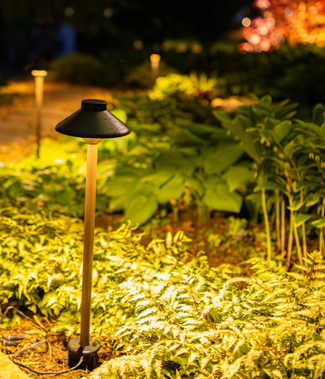
Path lights are not limited to walkways. The same fixtures work in planting beds to illuminate low-lying ground cover, at the base of specimen plants and along garden borders. Ask the homeowner where they spend time in the yard after dark — those areas are the most important to illuminate, regardless of whether they involve a defined path.
Material Options
Path light fixtures are available in aluminum, brass and copper. Aluminum is the most cost-effective and holds up well in most climates with a quality powder coat finish. Brass and copper develop a natural patina over time and are typically used in applications where the fixture is meant to be seen as a design element. All three are appropriate for direct in-ground installation.


