




Pressure-Regulating Spray Heads: How They Work and How Much Water They Save
Water rates are going up in most municipalities. In many regions, tiered pricing means the heaviest users pay the highest per-gallon rate — and irrigation is typically the largest single residential water draw during the growing season.
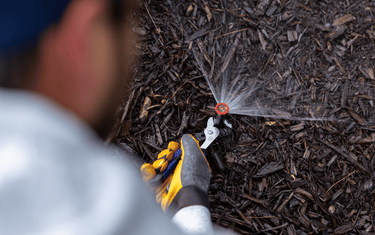
Pressure-regulating spray heads address a specific and measurable source of waste: excess pressure at the nozzle. When supply pressure exceeds the design range of the spray head, water atomizes into a fine mist before it reaches the turf. That mist is carried off target by wind, evaporates quickly, and delivers uneven coverage. The fix is built into the head.
The Numbers
A pressure-regulating head on a 15-foot half-pattern spray head operating at 60 minutes per week can save approximately 15 gallons per cycle compared with an unregulated head running at 40 PSI instead of the optimum 30 PSI. That calculation is based on a 10 PSI reduction. Reductions of 20 or 30 PSI, which are common on systems with no pressure regulation at all, produce proportionally larger savings.
The EPA reports that the average household with pressure-regulated spray heads installed saves approximately 2,400 gallons of water per year. On a 10-head residential installation, the water savings across a full irrigation season are meaningful — and the unit cost premium over a standard spray body is modest.
In regions with water restrictions or tiered utility rates, the efficiency improvement is directly visible on the water bill.
Installation Notes
Pressure-regulating spray bodies install exactly like standard spray bodies. There is no additional labor, no specialized tooling and no modification to the existing system. The regulation happens inside the head.
On systems already in operation, most heads can be swapped zone by zone during a routine maintenance visit without shutting down the entire system for an extended period.


