




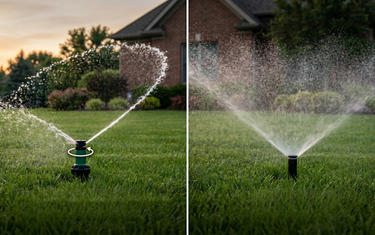
Sprays and rotors serve different purposes. Choosing the wrong one for the site leads to coverage problems, water waste and maintenance headaches.
The choice between spray heads and rotor heads is not a matter of preference, it is a function of site conditions. The right answer depends on the size and shape of the irrigated area, the topography, wind exposure, shade patterns and what kind of coverage is needed.
Start with those site factors, and the spray-versus-rotor decision usually follows them.
How Spray Heads Work
Spray heads (also called fixed spray heads) distribute water in a fixed fan pattern — a half circle, quarter circle or full circle — that does not move. The radius and pattern are determined by the nozzle installed on the head. Specialty nozzles are available for narrow strips, corners and irregular areas.
Spray heads are typically spaced up to 18 feet apart. They operate most efficiently between 20 and 30 PSI. Above 45 PSI, most spray heads begin misting; water atomizes and does not reach the ground effectively and is easily carried off target by wind. Pressure-regulating spray bodies address this directly by limiting operating pressure at the head regardless of supply pressure.
How Rotor and Rotary Heads Work
Rotor heads distribute water as a single rotating stream. Gear-driven rotors have largely replaced the older impact rotor design. They are quieter, more consistent and better suited to residential applications.
Rotary heads are a distinct category: they create multiple streams rather than a single one, and they are sized to fit standard spray body pop-ups. This makes them a direct swap for spray nozzles on existing spray-body installations.
Conventional guidance places rotary heads in the 15-to-35-foot radius range, but some designers use rotary heads on runs shorter than 15 feet for their efficiency advantage. For distances beyond 35 feet, standard rotor heads are the appropriate choice.
When to Use Sprays
Spray heads are the right choice for smaller, clearly defined areas like planting beds, tight side yards and spaces between hardscape features where precise coverage is needed and the area is relatively flat.
They apply water faster than rotors, which means shorter run times but also greater risk of runoff on slopes or compacted soil. They are simpler to position and adjust on smaller spaces. Maintenance is more involved in hard-water environments because calcium buildup can clog nozzles over time.
When to Use Rotors
Rotor heads are the right choice for larger turf areas, slopes and anywhere that a lower application rate is needed to let water absorb before runoff begins. Their lower precipitation rate makes them better suited to sloped sites and clay soils.
Installation takes more adjustment time than sprays. Rotors on irregular terrain need to be set, observed and often reset to establish correct arc and radius. Material costs per head are higher, but fewer heads are needed to cover the same area, which can offset the cost difference.
A Note on Costs
Spray heads cost less per unit than rotors, but spray systems require more pipe, more trenching and more valves to cover the same area. Rotor systems cost more per head but need fewer heads and less pipe for equivalent coverage. On larger projects, the total installed cost of both systems tends to be competitive. The deciding factor should be which technology is correct for the site, not which has a lower unit price.


